For offices, meeting rooms & occupied workplaces
Workplace CO₂ and environmental monitoring.
A focused environmental assessment brings CO₂, temperature and humidity patterns into view—with practical findings for the people responsible for your premises.
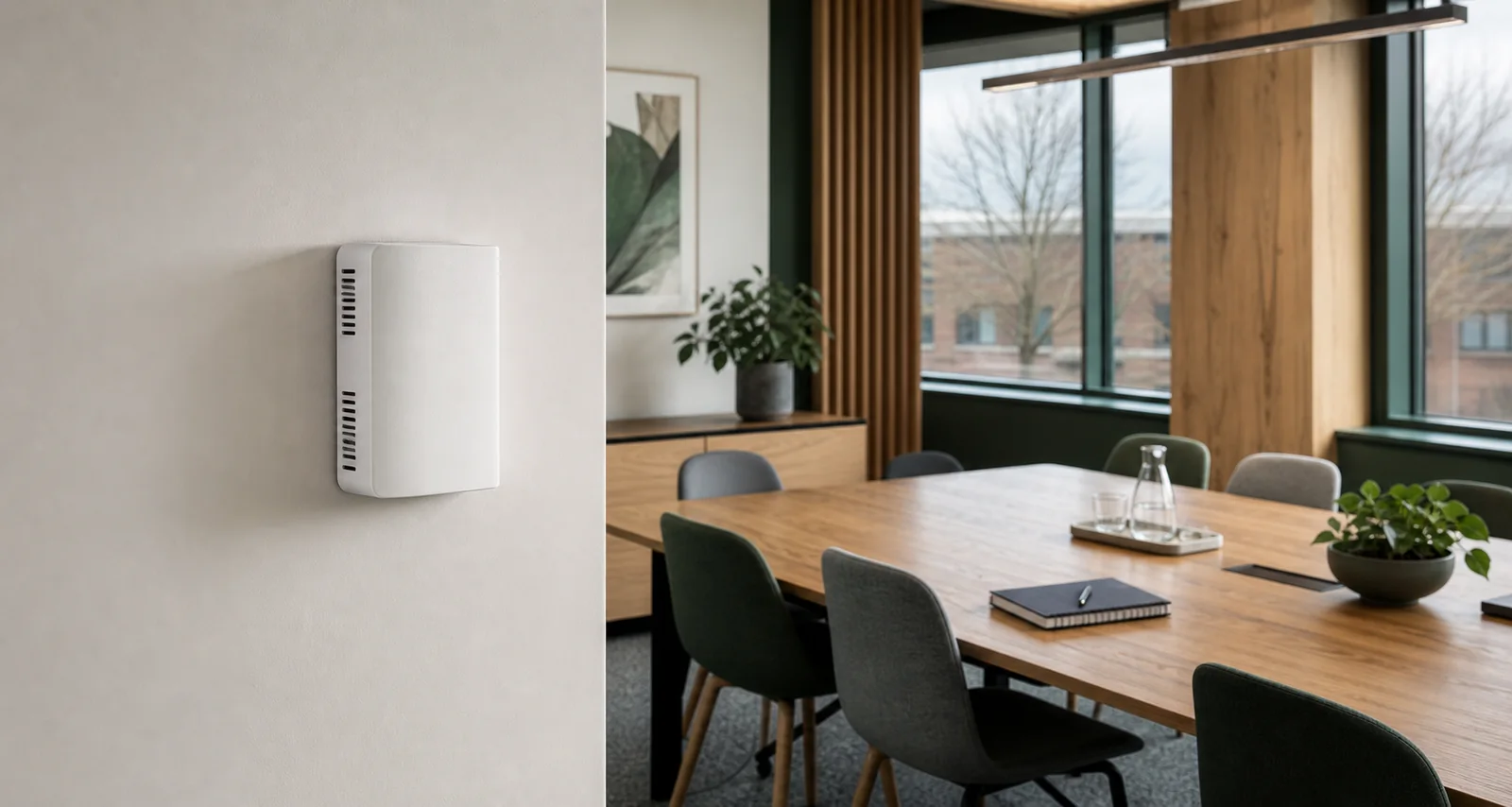
Make the working day visible.Illustrative scene · Equipment and scope agreed individually
What you receive
Make more informed decisions about your spaces.
The information you need, presented around the decisions you have to make.
- An agreed monitoring programme
- CO₂, temperature and humidity trends
- Room and outdoor context
- Findings and practical recommendations
Monitoring scope, sensor capability, room selection and reporting arrangements are agreed before the programme begins.
EnvIQ / WorkplaceIllustrative · Not customer data
Understand your rooms
See the daily pattern.
Meeting room · illustrative working day
20.5°CTemperature
50%Humidity
1,250 ppmCO₂
9.7°CCalculated dew point
Example with a compatible CO₂ sensor; equipment varies by service. Dew point is calculated from room air, not a measured surface temperature.
Outdoor context
12°C · 65% humidity
- Indoor moisture
- 1.21 kPa
- Outdoor moisture
- 0.91 kPa
Look at occupied periods
This example’s occupied-period CO₂ calls for a ventilation review. CO₂ is ventilation context, not a complete air-quality assessment.
Readings → context → practical next steps
Mould expertise first. Technology with purpose.
Developed by mould specialists at Mersey Mould.
EnvIQ starts with the property problem—not just the sensor. Our mould expertise shapes the questions we ask, the evidence we present and the practical guidance people receive.
How it works
A defined process. A useful outcome.
EnvIQ supplies and configures the equipment
Monitor representative occupied periods
Review findings and recommended next steps
CO₂, comfort & ventilation
See the patterns between the spot checks.
Compare occupied periods, room differences and recovery. CO₂ trends can help identify where ventilation deserves investigation, alongside temperature, humidity and room-use context.
- Supported CO₂ trends through the working day
- Agreed room and occupancy context
- Evidence for proportionate ventilation review
EnvIQ / WorkplaceIllustrative · Not customer data
Understand your rooms
See the daily pattern.
Meeting room · illustrative working day
20.5°CTemperature
50%Humidity
1,250 ppmCO₂
9.7°CCalculated dew point
Example with a compatible CO₂ sensor; equipment varies by service. Dew point is calculated from room air, not a measured surface temperature.
Outdoor context
12°C · 65% humidity
- Indoor moisture
- 1.21 kPa
- Outdoor moisture
- 0.91 kPa
Look at occupied periods
This example’s occupied-period CO₂ calls for a ventilation review. CO₂ is ventilation context, not a complete air-quality assessment.
Readings → context → practical next steps
Illustrative advice · Not customer data
Review ventilation while the room is in use
Use the room’s ventilation controls and check they are working. Where appropriate and safe, open windows briefly for fresh air. Review CO₂ trends alongside occupancy and room use.
Review the changeCompare similar occupied periods to understand whether CO₂ improves; one reading does not establish the cause.
Practical next steps
Advice with a reason behind it.
The platform connects available evidence to practical guidance. Sustained measured improvement can be acknowledged without claiming that a person definitely followed instructions.
Remaining warnings stay visible. Persistent condensation or visible mould may require inspection, not just different habits.
Updates that keep context
Know where to look next.
Current in-platform updates keep guidance and relevant follow-up connected to the evidence. Confirm which email notifications are included for your agreed service.
No SMS, mobile push or guaranteed real-time delivery is implied. Readings depend on equipment connectivity and reporting intervals.
EnvIQ · Example in-platform update
A clearer next step for your room
See the latest available conditions and the guidance that goes with them.
Updates matched to the service and available evidence
Delivery channels vary. This is not an SMS or push-notification promise.EnvIQILLUSTRATIVE REPORT
WORKPLACE ENVIRONMENTAL MONITORINGFrom readings.
From readings.
To understanding.
Room evidence · Findings · Next steps
What we observed
Patterns across the monitored period, with gaps and limitations visible.
What happens next
Practical recommendations linked to the available evidence.
Your report
The story of your property, backed by evidence.
A professional record explains what was measured, the patterns observed and what may warrant action or further investigation.
- Monitoring period, locations and data coverage
- Charts, findings and important limitations
- Practical recommendations tied to evidence
Useful to know
Your questions, answered.
Which spaces can be assessed?
Discuss offices, meeting rooms, dental practices and other occupied commercial premises. The room selection, equipment, period and interpretation are agreed for your particular setting.
Does a CO₂ monitor measure every air pollutant?
No. CO₂ gives useful ventilation context in occupied rooms, but does not measure every indoor pollutant or establish that a room is safe. Equipment capability and placement affect what can be concluded.
What will the report include?
The agreed monitoring period and locations, readings and trends, relevant room and outdoor context, evidence limitations, practical guidance and proportionate recommendations. Further specialist investigation may be appropriate.
Does this certify workplace compliance?
No. Environmental monitoring supports decisions; it is not a legal compliance certificate or a substitute for a suitable workplace risk assessment.
Monitoring supports informed decisions. It does not diagnose every building defect, measure every pollutant or certify legal compliance. Read about data security.
The knowledge centre
Good decisions start with understanding.
Condensation
Why condensation can hide behind furniture.
Room readings can miss cold surfaces. Learn what to check and when further investigation matters.
Read the guideWorkplace environments
What a workplace assessment can reveal.
Find out what monitoring can show, and where further investigation matters.
Read the guideProperty evidence
The evidence behind a mould investigation.
How room patterns and professional observations work together.
Read the guide